

The Escalating Challenge: Stalking, Intimidation, Harassment, and DARVO Tactics
As increasingly used by Service Providers Against Complainants, with a Focus on Neurodivergent Individuals

Executive Summary
This report addresses the concerning rise in stalking, intimidation, harassment, and DARVO (Deny, Attack, Reverse Victim and Offender) tactics employed by service providers to suppress complaints and stifle dissent, particularly impacting neurodivergent individuals. The analysis reveals that these behaviours, while legally defined in Australia, are often exploited due to ambiguities in legislation and systemic failures in accountability. DARVO, a psychological manipulation tactic, is frequently weaponised by organisations to discredit complainants and avoid responsibility, often exacerbated by underlying power imbalances and organisational cultures that prioritise reputation over ethical conduct.
Neurodivergent individuals face magnified vulnerabilities due stemming from communication differences, increased dependency on services, and a heightened susceptibility to psychological manipulation like gaslighting. These factors contribute to profound self-doubt, isolation, and trauma, creating significant barriers to reporting abuse and accessing support.
While Australian consumer law and disability service regulations, such as the NDIS Code of Conduct, aim to protect consumers and mandate ethical complaint handling, a persistent gap exists between policy and practice. The Disability Royal Commission's findings underscore systemic issues of abuse and neglect within disability services, highlighting the urgent need for comprehensive reforms. Strategic Lawsuits Against Public Participation (SLAPPs) are also emerging as a potent legal tool for silencing critics, further demonstrating the sophisticated nature of these suppressive tactics.
To foster a safer and more accountable environment, this report recommends strengthening legal protections, enhancing accessible and responsive complaint mechanisms, promoting neuro-inclusive practices and training for service providers, and empowering neurodivergent individuals through robust advocacy and support. Addressing this trend requires a multi-faceted approach that tackles legal loopholes, transforms organisational cultures, and provides tailored support for vulnerable populations.
1. Introduction: The Escalating Challenge of Service Provider Misconduct
1.1 Overview of the Problem: Silencing Dissent and Suppressing Complaints
A concerning trend has emerged where service providers increasingly employ tactics of stalking, intimidation, harassment, and DARVO (Deny, Attack, Reverse Victim and Offender) to silence complaints and suppress dissent. This phenomenon extends beyond individual grievances, reflecting broader societal patterns where powerful entities aim to control narratives and evade accountability. The tactics themselves are not confined to service provider-client relationships but represent universal tools of power, adaptable across various structures. For instance, foreign governments utilise similar strategies, including stalking, online disinformation campaigns, harassment, and abusive legal practices, to silence political and human rights activists, dissidents, and journalists.1 Similarly, within academic institutions, criticism of certain policies or actions can be met with measures perceived as silencing dissent, such as the cancellation of student discussions or disinvitations of speakers due to concerns about violating new guidelines.3 These examples illustrate that the "growing trend" within service provision is not an isolated occurrence but rather a manifestation of a larger, established pattern of power dynamics where those in positions of authority seek to control narratives and avoid accountability. This broader context underscores that the issue is not merely about individual consumer complaints but a more fundamental challenge to free expression and accountability within service delivery.
1.2 The Unique Vulnerability of Neurodivergent Individuals
The impact of these suppressive tactics is particularly severe for neurodivergent individuals, who face distinct experiences and challenges that heighten their vulnerability. Neurodivergent individuals, encompassing conditions such as autism, ADHD, dyslexia, and Tourette's syndrome, are estimated to constitute a significant portion of the population, ranging from 15% to 20%, with approximately 17% in the workforce.4 Despite this substantial presence, many neurodivergent professionals remain underrepresented in the workforce, often due to stigma or fear of negative consequences, leading to a reluctance to disclose their neurodivergence.4 This pre-existing societal vulnerability creates an environment ripe for exploitation.
A critical concept for understanding this magnified vulnerability is "epistemic injustice," defined as "harms that relate specifically to our status as epistemic agents, whereby our status as knowers, interpreters, and providers of information, is unduly diminished or stifled".5 This concept directly applies to neurodivergent individuals whose voices are frequently marginalized or dismissed within various systems, including healthcare. Autistic adults, for example, report numerous barriers to accessing healthcare, with many not seeking medical help for "potentially serious or life-threatening" conditions due to systemic and provider-level issues.5 The interplay of systemic failures and individual neurodivergent traits creates a magnified vulnerability to abuse and silencing. When individual traits, such as communication differences, increased dependency, or sensory sensitivities, interact with systemic failures and power imbalances inherent in service provision, the vulnerability is not merely additive but becomes significantly amplified. The existing systems are often not designed to accommodate diverse communication styles, and the unique traits of neurodivergent individuals can be exploited by abusive providers. This dynamic suggests that the silencing experienced by neurodivergent individuals is not accidental but often a direct consequence of how existing systems fail to adapt to their needs, making them susceptible to manipulation and further marginalisation.
2. Defining the Tactics: Stalking, Intimidation, Harassment, and DARVO
Understanding the precise nature of the abusive tactics—stalking, intimidation, harassment, and DARVO—is fundamental to identifying and addressing misconduct by service providers.
2.1 Legal Definitions and Scope in Australia
2.1.1 Stalking
In Australia, stalking is recognised as a criminal offence. Under Section 35 of the Crimes Act 1900 (ACT), stalking involves engaging in specific acts on at least two occasions with the intent to cause apprehension or fear of harm (which includes physical harm, harm to mental health, or disease), or to harass the person stalked.6 Prohibited acts encompass a range of behaviours, including following or approaching someone, loitering near or entering their residence, workplace, or frequented places, keeping them under surveillance, interfering with their property, sending or leaving offensive material, or making unwanted contact via telephone or electronic messages.6 It also includes acting covertly in a way that could reasonably be expected to arouse fear or engaging in conduct amounting to intimidation, harassment, or molestation.6 The Crimes (Domestic and Personal Violence) Act 2007 in NSW further defines stalking as a persistent course of conduct intended to maintain contact or exercise power and control, causing distress, fear, or harassment.7 Examples include unexplained access to social media accounts, leaving notes or unwanted gifts, or demonstrating awareness of a person's private conversations or movements without legitimate reason.7
A critical nuance in the ACT legislation is an exception for "reasonable conduct engaged in by a person as part of the person's employment if it is a function of the person's employment to engage in the conduct and the conduct is not otherwise unlawful".6 This clause presents a potential loophole that service providers could exploit to justify persistent, distressing contact under the guise of legitimate business operations. For instance, a service provider might argue that repeated calls or monitoring of a client, which could otherwise be construed as stalking behaviors, are necessary for "case management," "quality assurance," or "complaint resolution." This effectively shifts the burden onto the complainant to prove that the employment-related conduct was
unreasonable or unlawful, making it more challenging to pursue legal action. This legal nuance can inadvertently shield abusive service provider behaviour, particularly against vulnerable individuals who may already struggle to articulate the unreasonableness of such conduct or challenge authority. Stalking behaviours are broadly categorised into Surveillance (watching, tracking, monitoring online/offline), Life Invasion (unwanted contact, gifts, hacking accounts, harassing third parties), Intimidation, and Interference through sabotage or attack.8
2.1.2 Intimidation
Intimidation is also a criminal offence in Australia, with a broad definition under Section 545B of the Crimes Act 1900 (NSW). It is defined as "the causing of a reasonable apprehension of injury to a person or to the person's spouse, de facto partner, child or dependant, or of violence or damage to any person or property".9 The term "injury" is broadly interpreted to include harm to a person's property, business, occupation, employment, or other source of income, as well as any "actionable wrong".9 The intent element for intimidation requires that the act is performed "with a view to compel any other person to abstain from doing or to do any act which such other person has a legal right to do or abstain from doing".9 This intent is satisfied if the person knew their conduct was "likely" to cause fear.10 Courts consider various factors when determining if conduct amounts to intimidation, including the context of the interaction, the background between the parties, the degree of the intimidation (e.g., direct vs. conditional threats), the type of threat (e.g., words versus physical actions), the duration of the behavior, and the location where it occurred.10
The subjective interpretation of "reasonable apprehension" and "likely to cause fear" in intimidation laws creates a vulnerability that abusive service providers can exploit, particularly against neurodivergent individuals. Legal definitions of intimidation rely on concepts that require a subjective assessment of the victim's fear and the perpetrator's knowledge of its likelihood. Neurodivergent individuals often have distinct communication styles and may face difficulties in interpreting social cues or intentions.11 A service provider could engage in behaviour that is objectively intimidating to a neurodivergent person but then claim it was "reasonable" or "unlikely" to cause fear, leveraging the neurodivergent individual's unique processing to dismiss their experience. This legal ambiguity allows for a "grey area" of subtle, psychological intimidation that may not meet the high bar for criminal prosecution but still causes significant distress and suppresses complaints, disproportionately affecting those whose experiences might be easily dismissed or misinterpreted by others.
2.1.3 Harassment
Harassment generally involves a "pattern of behaviour or a course of conduct pursued by an individual with the intention of intimidating and distressing another person".13 This often includes "intruding into someone's private space and affairs, and perhaps misusing their personal information".13 The Australian Law Reform Commission (ALRC) notes that Australian courts have not recognised a common law cause of action for harassment, and existing civil remedies have "gaps and limitations".13 The ALRC has proposed a new statutory tort specifically for harassment to provide civil redress for "genuinely oppressive and vexatious" conduct that is "intentionally designed to harm or demean".13 Examples of conduct that, if repeated, unwanted, and intended to distress, may constitute harassment include following or keeping someone under surveillance, eavesdropping, reading private communications, using surveillance devices, publishing private information, and persistent unwanted contact via telephone or email.13
The absence of a recognised common law tort for harassment in Australia creates a significant legal gap that allows abusive service providers to engage in persistent, distressing behaviours without adequate civil recourse for victims. The ALRC's explicit statement that existing civil remedies are insufficient underscores this acknowledged deficiency in the current legal framework. This means that many forms of persistent, distressing, and privacy-invading conduct by service providers may not meet the higher thresholds for stalking or intimidation, leaving victims without effective civil legal avenues for redress. This legal lacuna enables service providers to operate within a "safe zone" of low-level, persistent harassment, knowing that their actions may not trigger significant legal consequences unless they escalate to criminal levels or fit very specific, narrow definitions. This disproportionately impacts vulnerable individuals who may already struggle to articulate their distress or navigate complex legal processes.
Table 1: Australian Legal Definitions of Stalking, Intimidation, and Harassment
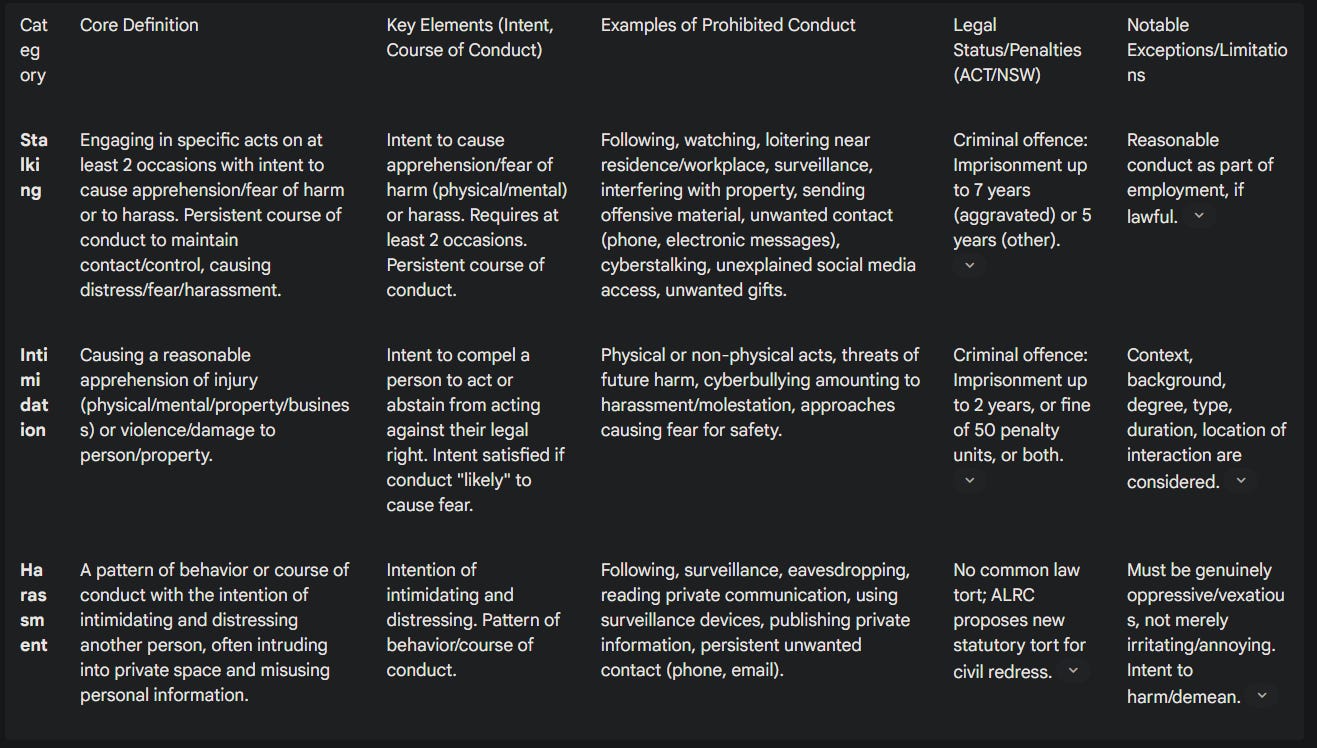
Stalking
Engaging in specific acts on at least 2 occasions with intent to cause apprehension/fear of harm or to harass. Persistent course of conduct to maintain contact/control, causing distress/fear/harassment.
Intent to cause apprehension/fear of harm (physical/mental) or harass. Requires at least 2 occasions. Persistent course of conduct.
Following, watching, loitering near residence/workplace, surveillance, interfering with property, sending offensive material, unwanted contact (phone, electronic messages), cyberstalking, unexplained social media access, unwanted gifts.
Criminal offence: Imprisonment up to 7 years (aggravated) or 5 years (other).6
Reasonable conduct as part of employment, if lawful.6
Intimidation
Causing a reasonable apprehension of injury (physical/mental/property/business) or violence/damage to person/property.
Intent to compel a person to act or abstain from acting against their legal right. Intent satisfied if conduct "likely" to cause fear.
Physical or non-physical acts, threats of future harm, cyberbullying amounting to harassment/molestation, approaches causing fear for safety.
Criminal offence: Imprisonment up to 2 years, or fine of 50 penalty units, or both.9
Context, background, degree, type, duration, location of interaction are considered.10
Harassment
A pattern of behaviour or course of conduct with the intention of intimidating and distressing another person, often intruding into private space and misusing personal information.
Intention of intimidating and distressing. Pattern of behaviour/course of conduct.
Following, surveillance, eavesdropping, reading private communication, using surveillance devices, publishing private information, persistent unwanted contact (phone, email).
No common law tort; ALRC proposes new statutory tort for civil redress.13
Must be genuinely oppressive/vexatious, not merely irritating/annoying. Intent to harm/demean.13
2.2 DARVO: A Psychological Manipulation Tactic
Beyond legal definitions, understanding psychological manipulation tactics like DARVO is critical, as they frequently underpin the "growing trend" of complaint suppression.
2.2.1 Understanding Deny, Attack, Reverse Victim and Offender
DARVO is an acronym coined by psychologist Jennifer Freyd, representing a behavioural pattern where a perpetrator or offender will "Deny the behaviour, Attack the individual doing the confronting, and Reverse the roles of Victim and Offender".14 This tactic aims to shift focus away from wrongdoing and avoid consequences.18
The components of DARVO manifest as follows:
Deny: The perpetrator outright denies the alleged behaviour, often stating, "That didn't happen," or feigning bewilderment and confusion, as if the accusation is entirely new to them.15 They may express righteous indignation, asserting, "How dare you accuse me of that, that's not the kind of person I am".18
Attack: The perpetrator attacks the accuser's credibility, mental competence, motives, or character.14 This often involves deflecting blame, criticising any evidence presented, or twisting personal information or secrets against the victim to discredit and shame them.18
Reverse Victim and Offender: The perpetrator assumes the victim role, portraying themselves as "falsely accused" and turning the true victim or whistleblower into the alleged offender.14 This "flips the narrative so that the abused becomes the villain".17
DARVO is a manipulative strategy that relies on emotion rather than facts, exploiting victims' fears such as fear of criticism, rejection, or public opinion.18 Research indicates that exposure to DARVO responses significantly impacts observers, leading to "less belief of the victim and more blame of the victim".15 Conversely, learning about DARVO can help mitigate these negative effects.15
When employed by service providers, DARVO leverages their inherent power and perceived credibility to systematically dismantle a complainant's narrative and psychological well-being, creating a potent silencing mechanism. Service providers, by virtue of their role, hold positions of authority and trust over their clients. When a service provider uses DARVO, their denial (e.g., "Our service quality is excellent, that couldn't have happened") carries more weight than an individual's denial. Their attack (e.g., "You're being unreasonable," "You're misinterpreting our policies," or even questioning the client's mental state) is particularly damaging because it emanates from an entity the client relies upon. The reversal of roles makes the client feel like they are the problem for even raising a complaint, leading to self-doubt and fear.18 This dynamic is further amplified by the organisational imperative to protect reputation, as HR and legal departments often prioritise shielding management and the organisation's public image.20 This transforms DARVO from an interpersonal manipulation tactic into an institutional tool for suppressing legitimate complaints, creating a chilling effect not only on the individual complainant but potentially on other clients who witness or hear about such responses, thereby discouraging future complaints and reinforcing the power imbalance.
2.2.2 The Link to Gaslighting and Coercive Control
DARVO is intimately linked to gaslighting, a form of psychological abuse where the perpetrator manipulates the victim into doubting their own memory, perception, or sanity through lies, distortion, withholding information, and trivialization.17 Gaslighting "rewrites the narrative" and "erodes their sense of trust in themselves, and their own judgement," making victims "easier to manipulate".17
Both DARVO and gaslighting are tactics employed within a broader pattern of "coercive control." Coercive control is a "prolonged and multifaceted campaign of abuse in order to gain and maintain dominance over the other partner".22 It often utilises non-violent tactics such as emotional abuse, economic abuse, monitoring, surveillance, isolation, and gaslighting to "destabilise a survivor's identity and sense of self".22
Neurodivergent individuals are particularly susceptible to gaslighting due to challenges in understanding social norms, identifying manipulative behaviour, and pre-existing self-doubt.12 They may "doubt their own reality when gaslighted" and "apologise for being 'too sensitive'," internalising blame and believing their feelings are not valid.21
DARVO and gaslighting employed by service providers against neurodivergent individuals constitute a pervasive form of coercive control, leading to profound epistemic injustice and systematic disempowerment. The established connection between DARVO, gaslighting, and coercive control indicates that when service providers, as authority figures, engage in these behaviours, the impact on neurodivergent clients is amplified. The aim of coercive control is to establish dominance and destabilise a victim's identity.22 For neurodivergent individuals, whose communication styles, interpretation of social cues, and existing self-doubt are already vulnerabilities 11, these tactics are particularly effective. This directly contributes to "epistemic injustice" 5, where the neurodivergent person's "status as knowers, interpreters, and providers of information, is unduly diminished or stifled." They are systematically made to doubt their own perceptions of abuse, hindering their ability to recognise, articulate, or report the harm. This reveals a deeper, more insidious form of abuse than isolated incidents, representing a systematic erosion of a neurodivergent individual's sense of reality and agency. This makes them not only less likely to complain but also less capable of trusting their own experiences, trapping them in abusive dynamics and perpetuating their vulnerability within the service system.
Table 2: Components and Impact of DARVO Tactics
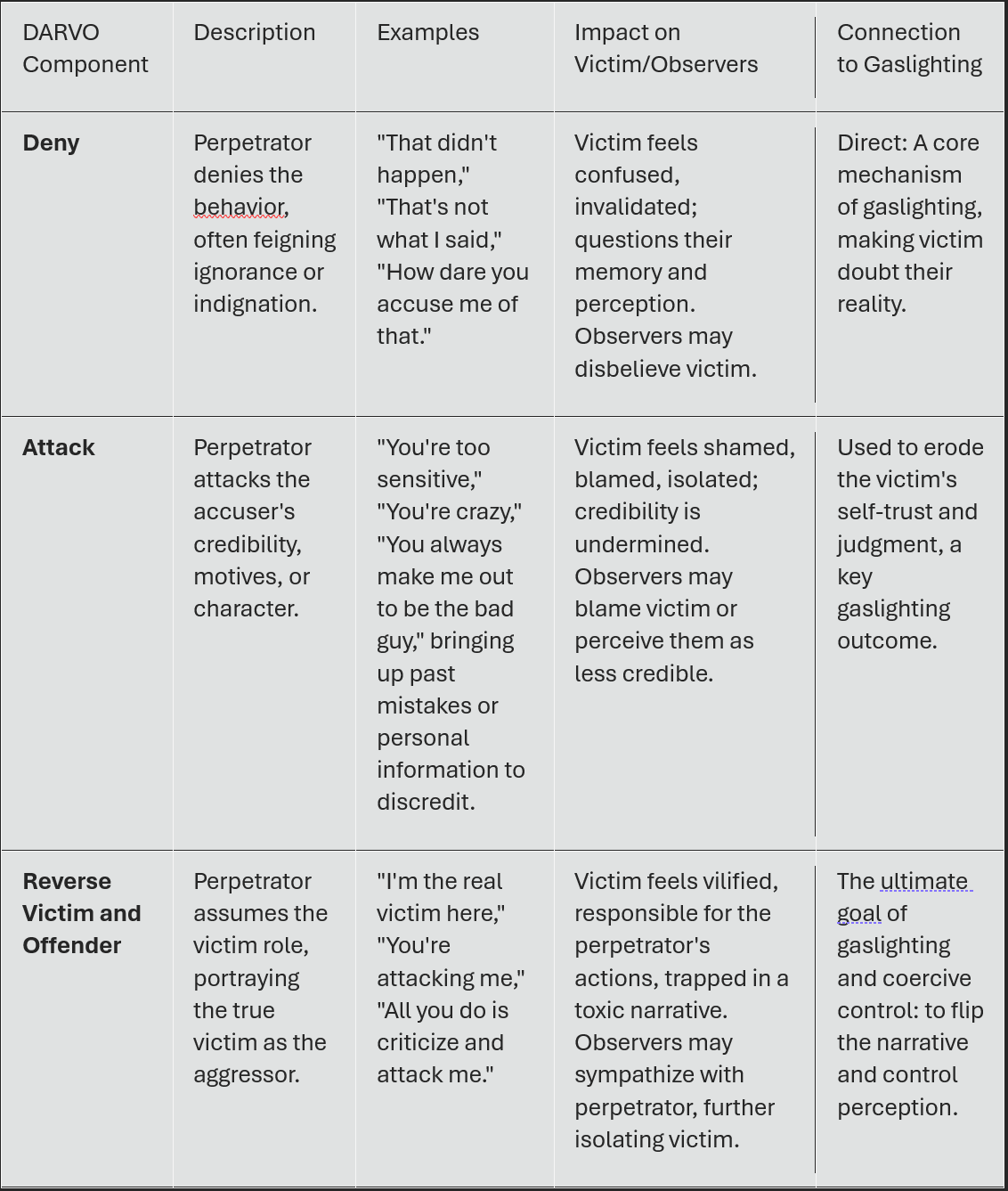
Deny
Perpetrator denies the behaviour, often feigning ignorance or indignation.
"That didn't happen," "That's not what I said," "How dare you accuse me of that?"
The victim feels confused, invalidated, and questions their memory and perception. Observers may disbelieve the victim.
Direct: A core mechanism of gaslighting, making victim doubt their reality.
Attack
Perpetrator attacks the accuser's credibility, motives, or character.
"You're too sensitive," "You're crazy," "You always make me out to be the bad guy," bringing up past mistakes or personal information to discredit.
Victim feels shamed, blamed, isolated; credibility is undermined. Observers may blame victim or perceive them as less credible.
Used to erode the victim's self-trust and judgment, a key gaslighting outcome.
Reverse Victim and Offender
Perpetrator assumes the victim role, portraying the true victim as the aggressor.
"I'm the real victim here," "You're attacking me," "All you do is criticise and attack me."
Victim feels vilified, responsible for the perpetrator's actions, trapped in a toxic narrative. Observers may sympathise with perpetrator, further isolating victim.
The ultimate goal of gaslighting and coercive control: to flip the narrative and control perception.
3. The "Growing Trend": How Service Providers Suppress Dissent
The observed "growing trend" of abusive tactics by service providers is not accidental but indicative of systemic mechanisms designed to suppress complaints and retaliate against those who speak out.
3.1 Mechanisms of Complaint Suppression and Retaliation
Service providers employ various tactics to suppress complaints and retaliate against individuals who voice concerns, often mirroring strategies seen in broader contexts of dissent suppression. These mechanisms can include online disinformation campaigns, direct harassment, intimidation, and threats.1 Abusive legal practices, such as initiating lawsuits, freezing assets, or withholding essential legal documents like passports, are also utilised.1 Harassment can extend beyond the direct complainant to their family members, amplifying the pressure to retract or remain silent.2
A common organizational response to complaints of psychological abuse is the DARVO pattern, where perpetrators and their employers "Deny their conduct and Attack the complainant".20 This organizational defense mechanism often sees HR and legal departments prioritizing the protection of "management, executives and the organization's public reputation" over genuinely addressing the complaint.20 This leads to victim blaming and shaming, a process that can be described as "crazymaking," where targets are gaslighted into "doubt[ing] their own eyes and ears about their situation" and feeling "crazy".20 The "RVO sequence" of DARVO is a predictable and typical response to those who dare to complain about abuse or harassment.20
Under Australian consumer law, businesses are prohibited from using "physical force, coercion or undue harassment against consumers" to sell products or services or to collect debts.23 "Undue harassment" is specifically defined as "unnecessary or excessive contact or communication with a person, to the point where the person feels intimidated, tired or demoralised".23 This includes unwanted persistent phone calls or over-the-top sales methods. Workplace bullying tactics, which can be adapted to consumer interactions, further illustrate these behaviours, including abusive language, aggressive and intimidating conduct, belittling or humiliating comments, unjustified criticism, spreading misinformation or malicious rumours, victimisation, deliberately excluding individuals, withholding vital information, and intruding on privacy.24
Organisations frequently attribute complaints to the "dissident's fault," criticising their personality as "touchy," "abrasive," or "paranoid".26 This "blaming the dissident" tactic is a common form of suppression. Despite the existence of ethical guidelines for complaint management from bodies like the NSW Ombudsman and the NDIS Code of Conduct, which emphasise respectful treatment, accessibility, and non-retaliation 27, the persistence of these abusive tactics indicates a significant gap between policy and practice. This persistent gap between espoused ethical guidelines for service providers and the reality of their complaint handling processes creates a fertile ground for abusive tactics and undermines trust. The direct contradiction between stated principles (e.g., respectful treatment, non-threatening complaint processes) and the observed "growing trend" of abusive tactics suggests that while formal policies exist, their implementation, enforcement, and the underlying organisational culture often fail to uphold these principles. This indicates that the problem is not a lack of regulatory intent or formal rules, but rather a systemic failure in accountability, cultural adherence, and practical enforcement within service provider organisations. This failure allows individual instances of abuse to continue, eroding consumer trust and discouraging legitimate complaints.
3.2 Strategic Lawsuits Against Public Participation (SLAPPs) as a Tool of Intimidation
Strategic Lawsuits Against Public Participation (SLAPPs) represent a sophisticated and increasingly common legal tactic employed by powerful entities, including businesses, to suppress criticism and silence dissent.30 SLAPPs are defined as the "improper, coercive use of legal action or threats of legal action... to suppress criticism".30 These lawsuits "exploit power and wealth inequalities" and "inhibit scrutiny and debate on matters of public interest".30
These legal actions frequently take the form of defamation claims 30 and often involve threats of legal action rather than progressing to formal proceedings, creating significant "financial and emotional strain" on targets.30 The Human Rights Law Centre highlights SLAPPs as a "growing threat to free speech and democracy in Australia," noting that Australia has "weak laws" and only one anti-SLAPP law in the ACT, which is considered insufficient to address the scope and sophistication of these tactics nationally.31
As observed in the context of DARVO, defamation lawsuits targeting abuse survivors "tick all the DARVO boxes," serving to deny guilt, attack credibility, and reverse victim and offender roles. They are "packaged in a lawsuit intended to intimidate, silence, and punish victims".15 The increasing use of SLAPPs by service providers represents a sophisticated escalation of DARVO tactics, leveraging the legal system to systematically silence complaints and create a pervasive chilling effect on public participation. The explicit link between defamation lawsuits (a common form of SLAPP) and DARVO demonstrates a direct escalation from psychological manipulation to formal legal weaponisation. The fact that SLAPPs frequently involve threats of legal action and create a "chilling effect on public discourse" 31 means the intimidation is effective even without full litigation, imposing significant financial and emotional strain on targets.31 This indicates that service providers are not only engaging in individual acts of abuse but are also utilising systemic legal vulnerabilities to silence critics, making it incredibly difficult for individuals, especially those with limited resources, to seek redress or speak out against misconduct. This undermines fundamental rights to free speech and public participation.
3.3 Organisational Culture and Institutional DARVO
The prevalence of these abusive tactics is often deeply embedded in, or enabled by, the organisational culture of service providers. "Institutional DARVO" occurs when the DARVO pattern is "committed by an institution (or with institutional complicity)".16 This behaviour is characterised as "cowardice by perpetrators and employers" who deny responsibility for their actions and attack complainants.20
Within organisations, HR and legal departments frequently prioritise protecting "management, executives and the organisation's public reputation".20 This institutional defence mechanism means that DARVO becomes a "typical response" to complaints, leading to the retention of abusive individuals and the marginalisation of those who raise concerns.20 Suppression tactics are typically implemented by "people in positions of power in organisations or associations," such as "business executives, government officials and leaders in professions".26 These individuals may genuinely believe their actions are justified and that the complainant is at fault, further entrenching the abusive dynamic.26
Poor organisational culture and a lack of leadership are identified as significant "main hazards" contributing to the prevalence of bullying and inappropriate behaviours.24 The NDIS Code of Conduct, specifically designed for disability service providers, explicitly acknowledges the inherent "power imbalance" between providers and participants and mandates that providers "must not threaten you for raising a concern or complaint".28 This indicates a regulatory recognition of these systemic issues within the disability sector. Furthermore, the Disability Royal Commission (DRC) highlighted issues with the governance of disability service providers, recommending periodic reviews, increased representation of people with disability on boards, and a focus on developing positive organisational cultures.35
Institutional DARVO is a direct consequence of organisational cultures that prioritise reputation and power protection over accountability and ethical complaint resolution, thereby exacerbating harm for vulnerable complainants. The explicit definitions and explanations of institutional DARVO confirm its purpose: to protect the organisation's image and management.16 The observation that suppression originates from those in power within organisations 26 and the link between poor organisational culture and inappropriate behaviours 24 illustrate how these dynamics are deeply entrenched. Despite the existence of codes of conduct that acknowledge power imbalances and prohibit threats 28, the DRC's findings reveal systemic governance failures and a lack of disability representation on boards.35 This creates an environment where complaints are not genuinely addressed but rather managed to protect the institution, leading to the predictable response of DARVO. This implies that the problem is deeply embedded in the very structure and values of some service provider organisations. Addressing this requires not just legal changes but a fundamental shift in corporate governance, leadership accountability, and a proactive embrace of human rights and neuro-inclusive practices from the top down, ensuring that protecting clients is prioritised over protecting institutional image.
4. Neurodivergent Individuals: Heightened Risks and Profound Impacts
Neurodivergent individuals face unique and magnified vulnerabilities to stalking, intimidation, harassment, and DARVO tactics due to inherent differences in communication, social processing, and sensory experiences, as well as societal factors that foster dependency.
4.1 Communication Differences and Misinterpretation of Social Cues
Neurodivergent individuals, including those with conditions such as autism, ADHD, dyslexia, or Tourette's syndrome, often exhibit variations in communication styles, sensory processing, and emotional regulation.11 These differences can make it challenging for them to "recognise and articulate abuse" or to "understand social norms or spot manipulative behaviour".11 This difficulty also extends to clearly expressing their experiences to authorities or support services.11
Some neurodivergent individuals may "echo social norms without fully understanding them," rendering them "easier targets for manipulation".21 Abusers can exploit their desire to "get it right" by "moving goalposts and making them feel like they're always in the wrong".21 Covert abuse, such as subtle put-downs disguised as jokes or gaslighting, is particularly difficult for neurodivergent people to recognize because it plays on "lifelong experiences of self-doubt, gaslighting, and communication differences".21
The inherent communication and social processing differences of neurodivergent individuals are not merely vulnerabilities but are actively weaponised by abusive service providers to dismiss complaints and gaslight victims. The repeated observation that neurodivergent individuals struggle with recognising and articulating abuse due to communication differences and difficulties with social cues 11 highlights a passive vulnerability. However, the explicit description of how abusers "exploit their desire to 'get it right'" and use "covert abuse" that plays on "lifelong experiences of self-doubt and communication differences" 21 demonstrates active exploitation. A service provider employing DARVO tactics can readily dismiss a neurodivergent person's complaint as a "misunderstanding," "misinterpretation," or even a sign of their "mental health issues," effectively using their neurodivergence against them to invalidate their experience. This highlights a critical need for service providers to receive specific training not just in general disability awareness, but in recognising and avoiding the exploitation of neurodivergent communication styles. It also underscores the importance of providing genuinely accessible and alternative communication methods for complaints, and for complaint handlers to be trained in neuro-inclusive, trauma-informed interviewing techniques.
4.2 Increased Dependency and Exploitation Vulnerabilities
Many neurodivergent individuals rely on family members, partners, or caregivers for support with daily tasks such as managing finances, transportation, or personal care.11 This reliance creates a significant "power imbalance" that abusers can exploit, making it "harder for victims to leave or seek help" due to the fear of losing essential support.11
Neurodivergent individuals possess a natural human need for belonging and connection, which predatory individuals or abusive service providers can exploit by drawing them into "unhealthy or into interactions with predatory individuals" or "abusive religious, wellness, self-development, or spiritual communities where they might face manipulation".36 They may also "tend to trust authority figures, spiritual or religious leaders implicitly," making them "more susceptible to those who misuse their position of trust and authority".36 Coercive control tactics, such as economic abuse (including restricting access to money, fraudulent use of funds, stealing, or forcing the surrender of assets) and isolation, are particularly effective in these contexts.22
The fundamental human need for belonging and support, combined with practical dependencies, renders neurodivergent individuals highly susceptible to coercive control and exploitation by service providers who become de facto authority figures, making escape and complaint-making profoundly difficult. The reliance of neurodivergent individuals on others for daily tasks 11 establishes an inherent power imbalance. This is further compounded by a natural desire for belonging and an often-implicit trust in authority figures.36 Abusive service providers can exploit these deep-seated needs, employing tactics like economic abuse 22 or social isolation 11 to maintain control. This extends beyond mere physical care to encompass financial and social spheres, making it incredibly difficult for the individual to recognise the abuse, extricate themselves, or seek external help, as their very survival or social connection may depend on the abuser. This highlights that the vulnerability is not just about individual traits but about how service providers, particularly in critical support roles, can transition from being essential helpers to instruments of coercive control. Policies must therefore address not only direct abuse but also the subtle mechanisms of control that leverage dependency and the need for belonging.
4.3 The Psychological Toll: Self-Doubt, Isolation, and Trauma
The psychological impact of these abusive tactics on neurodivergent individuals is severe and often long-lasting. Victims of DARVO and gaslighting can suffer "trauma-related symptoms, depression, anxiety and panic attacks".17 They may find it "difficult if not impossible to leave, believing themselves to be unlovable and so remain trapped in a toxic relationship".17 The effect on their well-being is described as "devastating and long-lasting".17 DARVO leaves victims "feeling isolated, invalidated and shamed," living in "fear of doing or saying anything that might be used against them".18 This results in feelings of "helplessness and hopelessness" and a "detrimental effect on their decision making, their self efficacy, their self esteem and their confidence".18 Stalking, too, can lead to "chronic anxiety, fear for personal safety, and hyper-vigilance," "significant emotional distress and depressive symptoms," "isolation" (often due to fear), and "trauma-related disorders, such as PTSD".38 Coercive control is specifically designed to "destabilize a survivor's identity and sense of self".22
Crucially, for neurodivergent individuals, gaslighting is "particularly damaging for those already struggling with self-doubt due to neurodivergent traits".11 They may "doubt their own reality when gaslighted" and "apologise for being 'too sensitive'," internalising blame and believing their feelings are not valid.21 This leads to profound "epistemic injustice," undermining their "agency and dignity".5
The psychological impact of service provider abuse on neurodivergent individuals is uniquely severe, leading to a profound erosion of self-trust and agency, which makes recovery and future complaint-making exceptionally challenging. The general psychological impacts of DARVO, gaslighting, and stalking are well-documented as severe.17 However, for neurodivergent individuals, these tactics leverage and exacerbate pre-existing vulnerabilities such as self-doubt, communication differences, and a tendency to internalise blame.11 This means the abuse is not just emotionally damaging; it is epistemically damaging 5, causing them to question their own perceptions, memories, and sanity. This deep erosion of self-trust 17 makes it "difficult if not impossible to leave" or seek help, creating a self-perpetuating cycle of abuse and silencing. The victim is not merely harmed but fundamentally disoriented regarding their own reality. This implies that traditional complaint mechanisms, which often rely on the complainant's ability to clearly articulate and consistently recount their experience, are inherently biased against neurodivergent individuals who have been subjected to this kind of abuse. Effective interventions must therefore go beyond addressing the immediate abuse to encompass long-term psychological support focused on rebuilding self-trust and agency, and complaint systems must be adapted to accommodate these impacts.
4.4 Barriers to Reporting and Accessing Support
Despite the severe impacts, neurodivergent individuals face significant barriers to reporting abuse and accessing support. Fewer than 1 in 5 stalking victims seek support from victim advocates, often feeling pressured by friends or family to "downplay the stalker's behaviour ".38 Neurodivergent individuals frequently experience "mistrust of authorities" due to past negative experiences where their needs were "misunderstood or dismissed".11 They often fear "not being believed" or that their concerns will be "dismissed due to their neurodivergence".11 Misdiagnosis and dismissal are common, as behaviours linked to trauma from abuse can overlap with neurodivergent traits.11
Difficulties with verbal communication, processing information, or expressing emotions "can make it harder for neurodivergent people to report abuse or explain their experiences".11 "Overwhelm and sensory challenges" can make navigating formal systems, such as legal processes or refuge environments, extremely difficult.12 The Disability Royal Commission (DRC) found that many people with disability "do not know where to access support and information relating to reporting violence and abuse" and highlighted the need for "more accessible information and advice".39 Specific examples from the DRC include a deafblind person struggling to communicate abuse at an airport and a deaf mother having her parenting ability questioned due to lack of interpreter access.41
The very systems designed to protect and support vulnerable individuals often inadvertently create additional barriers for neurodivergent complainants, reinforcing their isolation and perpetuating their silencing. Neurodivergent individuals already face inherent communication and social challenges.11 When they interact with formal complaint systems that are not neuro-inclusive (e.g., relying heavily on verbal communication, not understanding sensory needs, misinterpreting behaviours as defiance), these systems become additional barriers. The "mistrust of authorities" 11 is not an irrational response but a learned behaviour from repeated negative experiences of being misunderstood or dismissed. The DRC's findings 39 confirm that people with disability often lack awareness of support options and face accessibility issues in reporting. This systemic failure to accommodate diverse needs means that individuals who are already vulnerable due to abuse are further isolated by the very mechanisms intended to help them, perpetuating their silence and making it harder for them to seek justice.
Table 3: Specific Vulnerabilities of Neurodivergent Individuals to Abusive Tactics
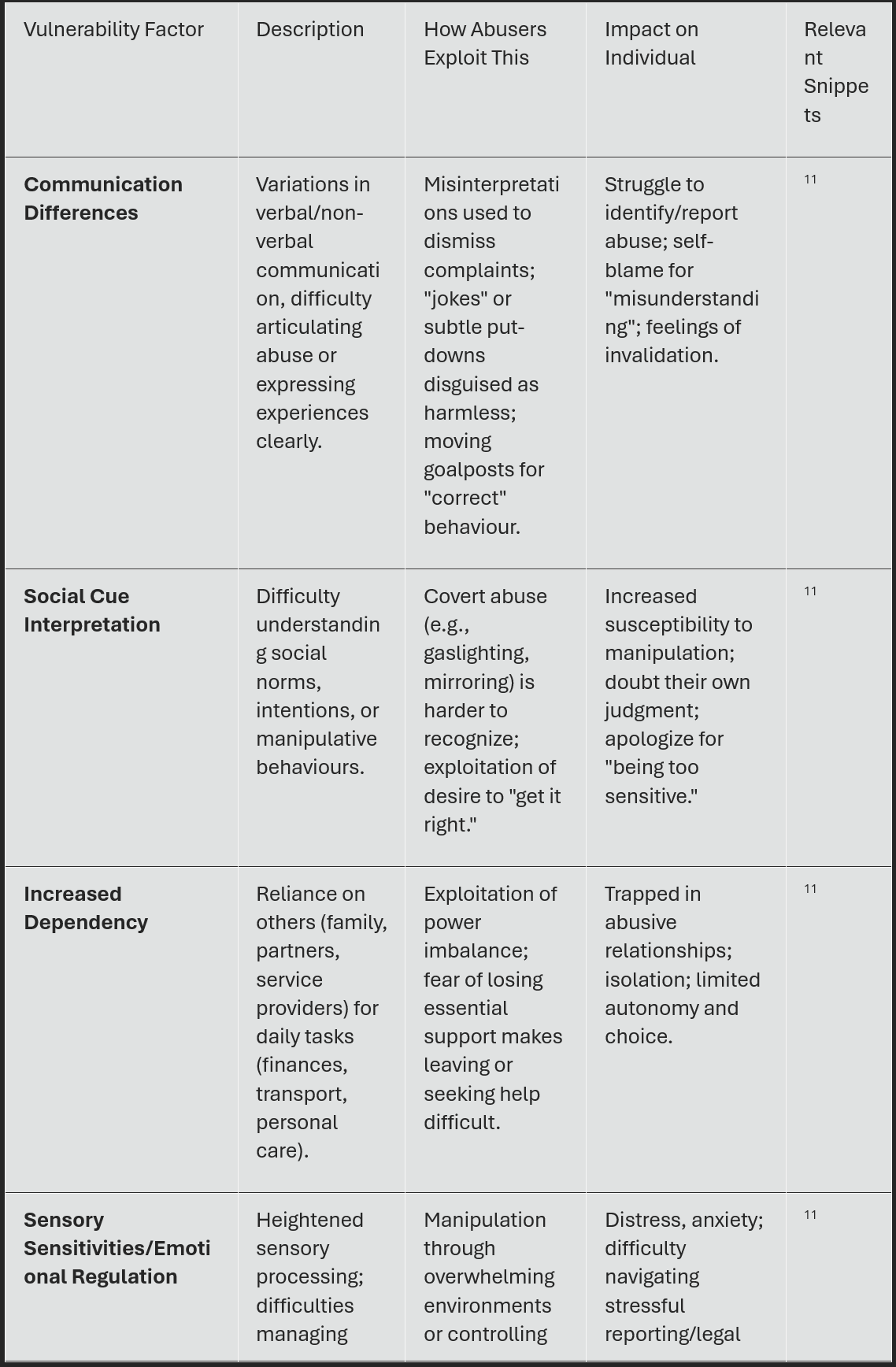
Communication Differences
Variations in verbal/non-verbal communication, difficulty articulating abuse or expressing experiences clearly.
Misinterpretations used to dismiss complaints; "jokes" or subtle put-downs disguised as harmless; moving goalposts for "correct" behavior.
Struggle to identify/report abuse; self-blame for "misunderstanding"; feelings of invalidation.
11
Social Cue Interpretation
Difficulty understanding social norms, intentions, or manipulative behaviours.
Covert abuse (e.g., gaslighting, mirroring) is harder to recognise; exploitation of desire to "get it right."
Increased susceptibility to manipulation; doubt their own judgment; apologise for "being too sensitive."
11
Increased Dependency
Reliance on others (family, partners, service providers) for daily tasks (finances, transport, personal care).
Exploitation of power imbalance; fear of losing essential support makes leaving or seeking help difficult.
Trapped in abusive relationships; isolation; limited autonomy and choice.
11
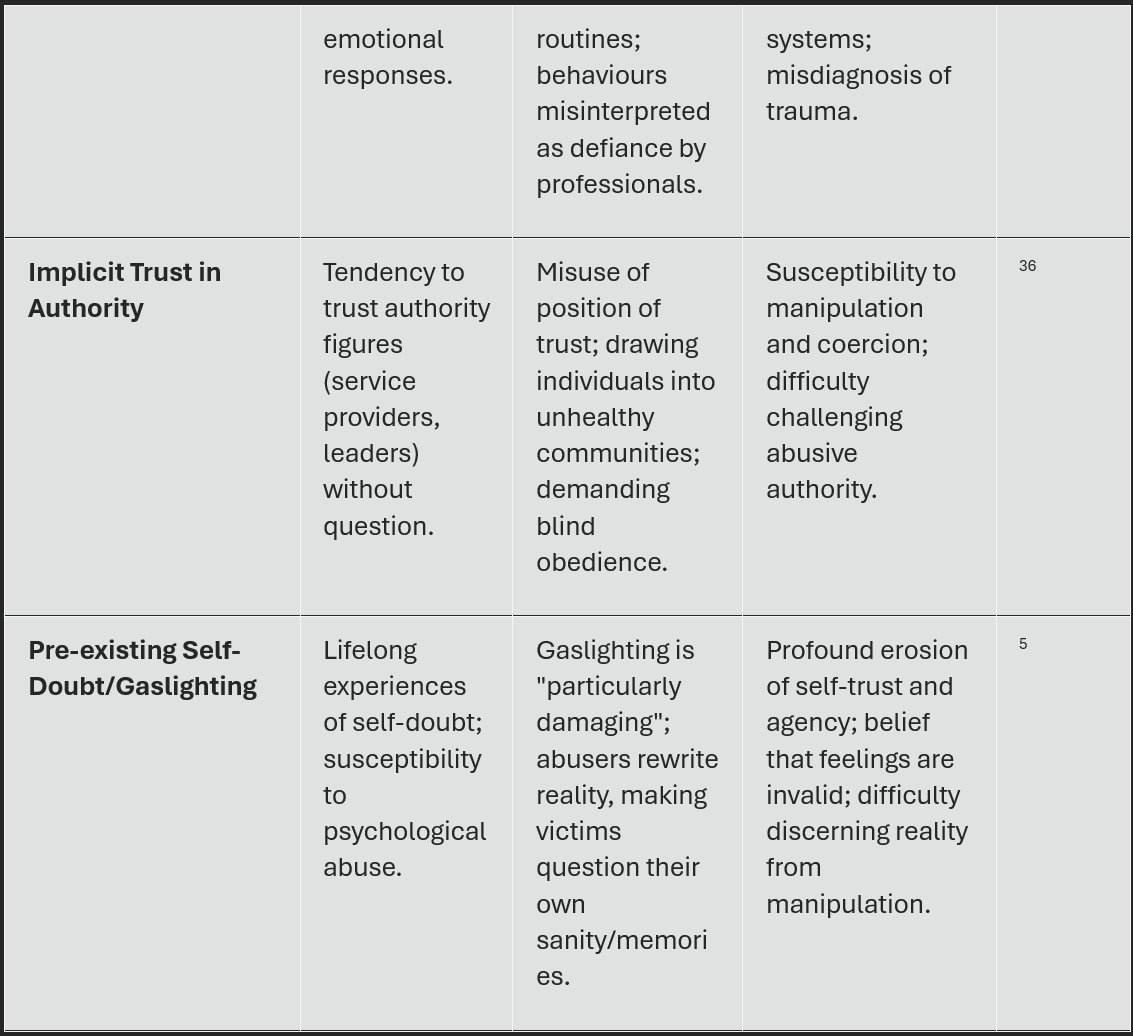
Sensory Sensitivities/Emotional Regulation
Heightened sensory processing; difficulties managing emotional responses.
Manipulation through overwhelming environments or controlling routines; behaviours misinterpreted as defiance by professionals.
Distress, anxiety; difficulty navigating stressful reporting/legal systems; misdiagnosis of trauma.
11
Implicit Trust in Authority
Tendency to trust authority figures (service providers, leaders) without question.
Misuse of position of trust; drawing individuals into unhealthy communities; demanding blind obedience.
Susceptibility to manipulation and coercion; difficulty challenging abusive authority.
36
Pre-existing Self-Doubt/Gaslighting
Lifelong experiences of self-doubt; susceptibility to psychological abuse.
Gaslighting is "particularly damaging"; abusers rewrite reality, making victims question their own sanity/memories.
Profound erosion of self-trust and agency; belief that feelings are invalid; difficulty discerning reality from manipulation.
5
5. The Australian Context: Regulatory Frameworks and Gaps
Australia has several regulatory frameworks designed to protect consumers and vulnerable individuals, but significant gaps persist, particularly concerning the specific tactics employed by service providers to suppress complaints.
5.1 Consumer Protection Laws and Unfair Business Practices (ACCC)
The Australian Competition and Consumer Commission (ACCC) plays a crucial role in enforcing consumer protection laws. The ACCC accepts and records reports of business practices and behaviours that concern consumers, using this data to inform investigations, enforcement actions, and educational activities.23 It helps consumers understand their rights and identifies unfair practices.23
Under Australian Consumer Law (ACL), it is illegal for businesses to use "physical force, coercion or undue harassment against consumers" to sell products or services or to collect debts.23 "Coercion" involves using force or threats to restrict someone's choice, or exploiting known facts to compel action.23 "Undue harassment" refers to "unnecessary or excessive contact or communication... to the point where the person feels intimidated, tired or demoralised," including unwanted persistent phone calls or over-the-top sales methods.23 The ACL also prohibits misleading or deceptive conduct, unfair contract terms, and unconscionable conduct.43
Despite these protections, the ACCC primarily focuses on "widespread harm" and does not typically resolve individual complaints or provide legal advice.42 While it can investigate and take enforcement action for unfair practices, the onus often falls on individuals to pursue resolution or report patterns of behavior that may not immediately meet the threshold for ACCC intervention. This leaves a gap for individuals experiencing persistent, but perhaps less widespread, forms of harassment or intimidation.
5.2 The National Disability Insurance Scheme (NDIS) Code of Conduct and Safeguards
For people with disability, the National Disability Insurance Scheme (NDIS) Code of Conduct is a key regulatory instrument. It mandates that all NDIS providers, key personnel, and workers respect and uphold the rights of participants, ensuring access to safe and ethical supports and services without experiencing or fearing violence, abuse, neglect, exploitation, or discrimination.28
The Code explicitly requires providers to:
Treat people with disability with dignity and respect, upholding their human rights.34
Act with respect for individual rights to freedom of expression, self-determination, and decision-making.28
Provide supports and services in a safe and competent manner, with care and skill.28
Act with integrity, honesty, and transparency.28
Promptly raise and act on concerns about quality and safety.28
Take all reasonable steps to prevent and respond to all forms of violence, exploitation, neglect, and abuse, including sexual misconduct.28
Never abuse, exploit, harass, or neglect a person with disability.34
Recognise the "power imbalance" between themselves and the person receiving support, and how this affects appropriate behaviour.34 They "must not threaten you for raising a concern or complaint".28
The NDIS Quality and Safeguards Commission is responsible for overseeing compliance, registering providers, monitoring incidents, and building the capacity of participants to understand their rights.45 Participants are encouraged to first raise concerns with their provider, but if uncomfortable or dissatisfied, they can contact the NDIS Commission directly.28 Despite these comprehensive guidelines, the Disability Royal Commission's findings indicate that significant challenges remain in practice, particularly regarding the effective prevention and response to abuse within disability services.
5.3 Key Findings and Recommendations from the Royal Commission into Violence, Abuse, Neglect and Exploitation of People with Disability
The Royal Commission into Violence, Abuse, Neglect and Exploitation of People with Disability (DRC), which ran for nearly four and a half years and concluded in September 2023, gathered extensive evidence of violence, abuse, neglect, and exploitation across all settings.40 Almost 10,000 people shared their experiences, revealing horrifying stories and systemic drivers of unjust treatment.39 The Final Report, comprising 12 volumes and 222 recommendations, aims to transform Australia into a more inclusive society where people with disability live free from violence, abuse, neglect, and exploitation.40
Key findings from the DRC relevant to service provider accountability and complaint handling include:
High Rates of Violence and Neglect: People with disability experience significantly higher rates of violence, particularly women with psychological or intellectual disability, First Nations women, and young women with disability.52 Disturbing accounts of severe deprivation and deaths due to gross neglect were heard.52
Failures in Service Provision: Disability services often failed to prevent maltreatment or to respond effectively to complaints and incidents. Problems in organisational cultures, systems, policies, and practices contributed to abuse.45
Lack of Support for Autonomy and Participation: Many people with disability are not supported to learn, develop skills, or participate in the community, leading to lasting trauma and harm.45 They are often denied the right to make decisions and control their lives.52
Barriers to Complaint Mechanisms: Existing complaint systems are often too complex, with many people with disability unaware of where to access support or information for reporting abuse.39
Power Imbalances: The Commission noted the pervasive power imbalances in disability services and the need for greater participant choice and control.45
The DRC made extensive recommendations to address these issues, including:
A Disability Rights Act: To strengthen human rights protection and ensure people with disability live free from exploitation, violence, and abuse.52
Supported Decision-Making: Reforms to laws and practices to ensure people with disability can make their own decisions with support, promoting supported decision-making and reducing restrictive practices.40
Accessible Information and Communication: Reforms to address barriers to accessing information and services, including increased access to skilled interpreters.45
Improved Complaint Mechanisms: Establishment of an accessible "one stop shop" for reporting complaints, referrals, and support in each state and territory.40 This mechanism should provide advice on reporting options and make referrals to relevant bodies or advocacy services.54
Enhanced Oversight: Implementation of adult safeguarding laws, community visitor schemes, and disability death review schemes to monitor and respond to abuse and neglect.40
Service Provider Accountability: Requirement for all disability service providers to embed human rights in their design and delivery of products and services.45 This includes transparent policies for detecting and responding to violence, abuse, and neglect, and rigorous screening, recruitment, training, and supervision for support workers.40
Governance Reforms: Periodic review of governance arrangements, increased representation of people with disability on boards, and fostering positive organisational cultures.35
The DRC's findings underscore the critical need for systemic change to ensure that service providers are genuinely accountable and that complaint mechanisms are effective and accessible for all, especially neurodivergent individuals.
Table 4: Key Recommendations from the Disability Royal Commission Relevant to Service Provider Accountability and Complaint Handling
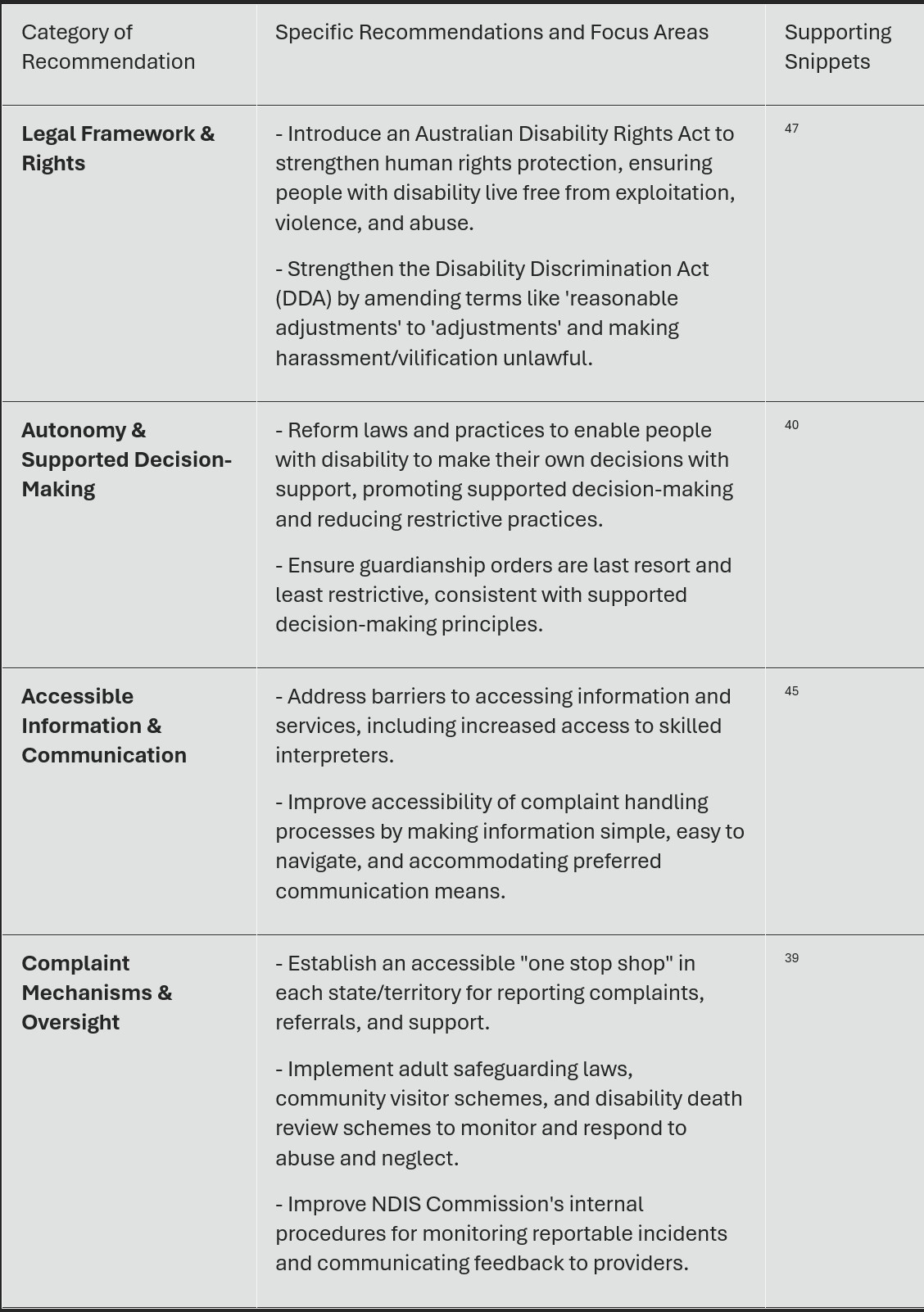
Legal Framework & Rights
- Introduce an Australian Disability Rights Act to strengthen human rights protection, ensuring people with disability live free from exploitation, violence, and abuse.
- Strengthen the Disability Discrimination Act (DDA) by amending terms like 'reasonable adjustments' to 'adjustments' and making harassment/vilification unlawful.
47
Autonomy & Supported Decision-Making
- Reform laws and practices to enable people with disability to make their own decisions with support, promoting supported decision-making and reducing restrictive practices.
- Ensure guardianship orders are last resort and least restrictive, consistent with supported decision-making principles.
40
Accessible Information & Communication
- Address barriers to accessing information and services, including increased access to skilled interpreters.
- Improve accessibility of complaint handling processes by making information simple, easy to navigate, and accommodating preferred communication means.
45
Complaint Mechanisms & Oversight
- Establish an accessible "one stop shop" in each state/territory for reporting complaints, referrals, and support.
- Implement adult safeguarding laws, community visitor schemes, and disability death review schemes to monitor and respond to abuse and neglect.
- Improve NDIS Commission's internal procedures for monitoring reportable incidents and communicating feedback to providers.
39
Service Provider Accountability
- Require all disability service providers to embed human rights in the design and delivery of products and services.
- Develop model procedures for frontline workers on recognising/reporting incidents and handling complaints using person-centered approaches.
- Strengthen self-advocacy skills and access to independent advocacy for people with disability.
- Implement transparent policies for detecting and responding to violence, abuse, neglect, and rigorous screening, recruitment, training, and supervision for support workers.
40
Governance & Culture
- Conduct periodic reviews of governance arrangements for service providers.
- Increase meaningful representation of people with disability on boards and in leadership structures.
- Foster positive organisational cultures that prioritise human rights and accountability.
35
6. Recommendations for a Safer and More Accountable Environment
Addressing the growing trend of abusive tactics by service providers, particularly against neurodivergent individuals, requires a multi-faceted approach encompassing legal reform, enhanced complaint mechanisms, cultural transformation within organisations, and robust empowerment of vulnerable populations.
6.1 Strengthening Legal Protections and Enforcement
Current Australian legal frameworks, while providing some protections, exhibit gaps that can be exploited by abusive service providers. To enhance legal safeguards:
Clarify and Restrict the "Employment Exception" in Stalking Laws: The current exception for "reasonable conduct" in employment 6 needs clearer guidelines or a re-evaluation, especially in contexts involving power imbalances. This clarification should ensure that persistent, distressing contact by service providers, even if framed as "work-related," cannot be used to justify abusive behaviour. The burden of proving the unreasonableness of such conduct should not disproportionately fall on vulnerable complainants.
Enact a Statutory Tort of Harassment: As recommended by the ALRC 13, a specific civil tort for harassment is necessary to provide redress for patterns of behaviour that are genuinely oppressive and vexatious but may not meet the high threshold for criminal stalking or intimidation. This would provide a more accessible legal avenue for victims to seek civil remedies, including damages, for intentional and demeaning conduct.
Implement Comprehensive Anti-SLAPP Legislation: Given the increasing use of Strategic Lawsuits Against Public Participation (SLAPPs) to silence critics 30, Australia needs nationally consistent, robust anti-SLAPP laws. These laws should provide mechanisms for early dismissal of abusive lawsuits, shift the burden of proof to the plaintiff to demonstrate genuine public interest, and offer protections for defendants, thereby safeguarding freedom of speech and public participation.
Enhance Enforcement of Unfair Business Practices: The ACCC's role in addressing "undue harassment" and "coercion" by businesses 23 should be strengthened to proactively investigate and penalise service providers engaging in these tactics, even for individual complaints that demonstrate a pattern of abuse. Greater public reporting and transparency regarding such enforcement actions could also act as a deterrent.
6.2 Enhancing Accessible and Responsive Complaint Mechanisms
The effectiveness of legal protections hinges on accessible and responsive complaint mechanisms. Reforms should focus on making these systems genuinely inclusive:
Establish a "One Stop Shop" for Complaints: As recommended by the Disability Royal Commission 40, each state and territory should establish an accessible central point for people with disability to receive advice, information, and referrals regarding reporting options. This mechanism must be co-designed with people with disability to ensure it is user-friendly and responsive to diverse needs.
Implement Neuro-Inclusive Complaint Processes: Complaint systems must accommodate varied communication styles and sensory needs. This includes offering multiple communication methods (e.g., text, email, visual aids), providing trauma-informed training for complaint handlers, and ensuring that behaviours linked to neurodivergent traits or trauma are not misinterpreted as defiance or unreliability.11
Mandate Transparent and Accountable Complaint Handling: Service providers should be required to have clear, publicly available complaint policies that detail processes, timeframes, and avenues for escalation. They must ensure that complainants can raise concerns without fear of retaliation.27 The NDIS Commission should improve its monitoring of reportable incidents and ensure feedback loops with providers and participants are effective.45
6.3 Promoting Neuro-Inclusive Practices and Training for Service Providers
A fundamental shift in organisational culture is necessary to prevent abusive tactics. This requires proactive measures:
Embed Human Rights and Neuro-Inclusion in Service Design: Service providers, particularly those in the disability sector, must integrate human rights principles into every aspect of their service design and delivery.45 This includes adopting universal design principles and ensuring services are inherently accessible and respectful of neurodiversity.
Mandatory Neuro-Inclusive Training: Comprehensive and ongoing training for all service provider staff, from frontline workers to senior management, is crucial. This training should cover:
Understanding neurodiversity, communication differences, and sensory sensitivities.11
Recognising and preventing manipulative behaviours, including DARVO and gaslighting.14
Ethical complaint handling, power imbalances, and the prohibition of retaliation.28
Trauma-informed approaches to interactions with vulnerable individuals.
Transform Organisational Governance and Culture: Organisations must prioritise accountability over reputation protection. This involves:
Periodic reviews of governance arrangements to ensure they are fit for purpose and reflect human rights-based service delivery.35
Increasing the meaningful representation of people with disability on boards and in leadership structures, fostering an "authorising environment" for inclusive practices.35
Cultivating a positive and respectful work culture where bullying and inappropriate behaviours are not tolerated.24
6.4 Empowering Neurodivergent Individuals and Advocacy Services
Empowering neurodivergent individuals to recognise and respond to abuse is vital:
Strengthen Independent Advocacy: Provide increased and sustained funding for independent disability advocacy organisations.53 These services are critical for supporting neurodivergent individuals in understanding their rights, articulating their experiences, and navigating complex complaint and legal systems.11
Education and Awareness Campaigns: Develop and disseminate accessible educational materials for neurodivergent individuals and their support networks on recognising abusive behaviours (including DARVO and gaslighting), understanding their rights, and knowing how to seek help.11
Promote Self-Efficacy and Self-Trust: Support services should focus on rebuilding self-trust and agency for individuals who have experienced psychological abuse, recognising the profound epistemic injustice they may have endured.5 This includes therapeutic interventions tailored to neurodivergent experiences.
Data Collection and Research: Improve data collection on complaints, particularly those involving neurodivergent individuals and the specific tactics used, to better understand the scope of the problem and inform evidence-based interventions.
7. Conclusion
The growing trend of service providers employing stalking, intimidation, harassment, and DARVO tactics to suppress complaints and dissent represents a serious threat to consumer rights and, more acutely, to the well-being and autonomy of neurodivergent individuals. The analysis underscores that these are not isolated incidents but rather manifestations of systemic power imbalances, legal ambiguities, and organisational cultures that prioritise self-preservation over ethical conduct.
Neurodivergent individuals face a compounded vulnerability due to inherent communication differences, increased reliance on services, and a heightened susceptibility to psychological manipulation. These factors lead to severe psychological impacts, including profound self-doubt and isolation, and create formidable barriers to reporting abuse and accessing support.
While Australia has foundational consumer protection laws and specific safeguards within the NDIS, the findings of the Disability Royal Commission reveal persistent failures in preventing and responding to abuse within disability services. The rise of SLAPPs further demonstrates a sophisticated weaponisation of the legal system to silence legitimate criticism.
Addressing this complex issue demands a comprehensive and coordinated response. Strengthening legal protections, enhancing accessible and neuro-inclusive complaint mechanisms, fostering a culture of accountability and human rights within service organisations, and empowering neurodivergent individuals through targeted support and advocacy are critical steps. Only through such concerted efforts can a truly safe, inclusive, and just society be built where all individuals, particularly the most vulnerable, can voice their concerns without fear of retribution and receive the ethical services they deserve.